Dog Heatstroke: Symptoms, First Aid and Prevention
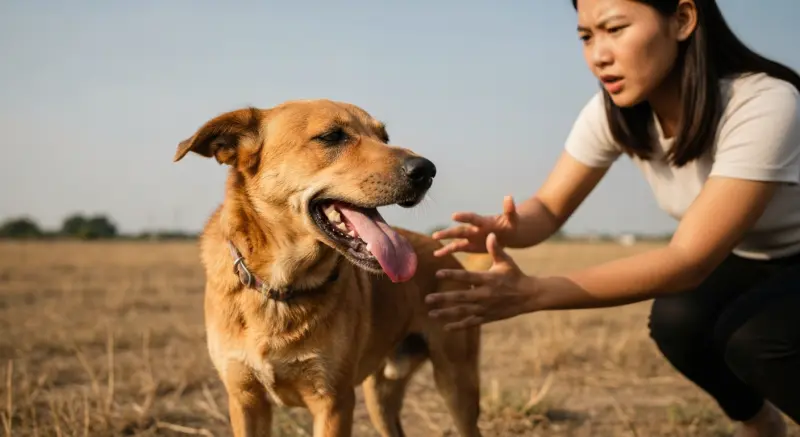
Heatstroke (hyperthermia) is a veterinary emergency that takes the lives of 15% of affected dogs, according to the British Veterinary Association (2023). Unlike humans, dogs do not sweat efficiently — they regulate their temperature mainly by panting. When that mechanism is overwhelmed, body temperature climbs past 41 degrees and the organs begin to fail.
The symptoms of canine heatstroke
Spotting the early signs is crucial because every minute counts. Heatstroke develops in three distinct stages, from alert to life-threatening danger.
Stage 1 — Mild heat stress
Your dog pants more than usual, drools heavily and actively seeks shade or cool surfaces. They may seem restless, lying down then getting up again. Their nose is hot and dry. At this stage, simple rest in the shade with cool water is usually enough. A cooling mat can bring their temperature down by 5 to 8 degrees in minutes.
Stage 2 — Moderate hyperthermia
Panting becomes very rapid and shallow. The gums turn dark red or purplish instead of their usual pink. The dog may stagger, vomit or have diarrhoea. The heart rate speeds up abnormally. You must act immediately: wet the dog with tepid water (never ice-cold) and provide air flow.
Stage 3 — Life-threatening emergency
The dog collapses, loses consciousness or has seizures. The gums turn grey or white. Blood may appear in vomit or stools. Body temperature exceeds 42 degrees. This is an absolute emergency: head to the emergency vet immediately while cooling the dog during transport.
First-aid steps
As soon as you suspect heatstroke, act without delay. According to the University of Nottingham (a 2020 study of 904 cases), dogs cooled before arriving at the vet had a 98% survival rate, against 80% for those that were not cooled.
- Move the dog away from the heat source — shade, an air-conditioned room, a ventilated car
- Apply tepid water (15-20 degrees) to the neck, groin and paws. Ice-cold water is counterproductive as it triggers vasoconstriction that traps the heat
- Create air flow with a fan, a magazine, or open car windows
- Offer cool water without forcing it. Small, frequent amounts
- Contact your vet even if the dog seems to recover — internal complications can appear up to 48 hours later
High-risk breeds
Some breeds are especially vulnerable to heatstroke. Brachycephalic (flat-faced) breeds are on the front line because their narrow airways limit panting.
- Very high risk: French Bulldog, English Bulldog, Pug, Boxer, Shih Tzu, Pekingese
- High risk: Husky, Malamute, Newfoundland, Saint Bernard, Chow Chow (dense coats)
- Moderate risk: Labrador, Golden Retriever, German Shepherd (intense activity in strong heat)
Overweight, elderly or heart- and respiratory-conditioned dogs also need close watching. According to the Kennel Club UK (2022), French Bulldogs are six times more likely to suffer heatstroke than the average breed.
Prevention: 5 essential rules
The best treatment for heatstroke remains prevention. These five simple rules protect your dog throughout the summer.
- Walk during the cool hours — before 9am and after 7pm in summer. Test the pavement with your hand: if it is too hot for you, it burns your dog's pads
- Fresh water at all times — change the water 2-3 times a day, add ice cubes. A 20 kg dog should drink at least 1 litre a day, more in strong heat
- A cool surface available — a cooling mat offers a cool zone accessible around the clock with no electricity
- Never in a parked car — even with the windows cracked, the temperature rises by 10 degrees in 10 minutes. A cabin at 25 degrees reaches 45 in 30 minutes
- Watch the panting — heavy panting that does not settle after 10 minutes of rest in the shade is a warning sign

In summary
Heatstroke is avoidable with the right precautions. Watch your dog whenever the temperature climbs above 25 degrees, fit activities to the cool hours, and give them constant access to water and a cool surface. A gel cooling mat is a simple investment that can save your companion's life. Do read our full guide to keeping your dog cool.